
Larch vs Western Red Cedar: Which Timber is Right for Your Cladding Project?
Larch and Western Red Cedar are two of the most popular choices for external timber cladding in the UK — and for good reason. Both are naturally durable, beautiful to look at, and versatile enough to suit a wide range of building styles, from modern garden rooms to traditional rural homes. However, each has distinct characteristics in terms of colour, durability, cost, and performance.
In this guide, we compare larch cladding vs western red cedar cladding in detail, so you can decide which is the right fit for your project.
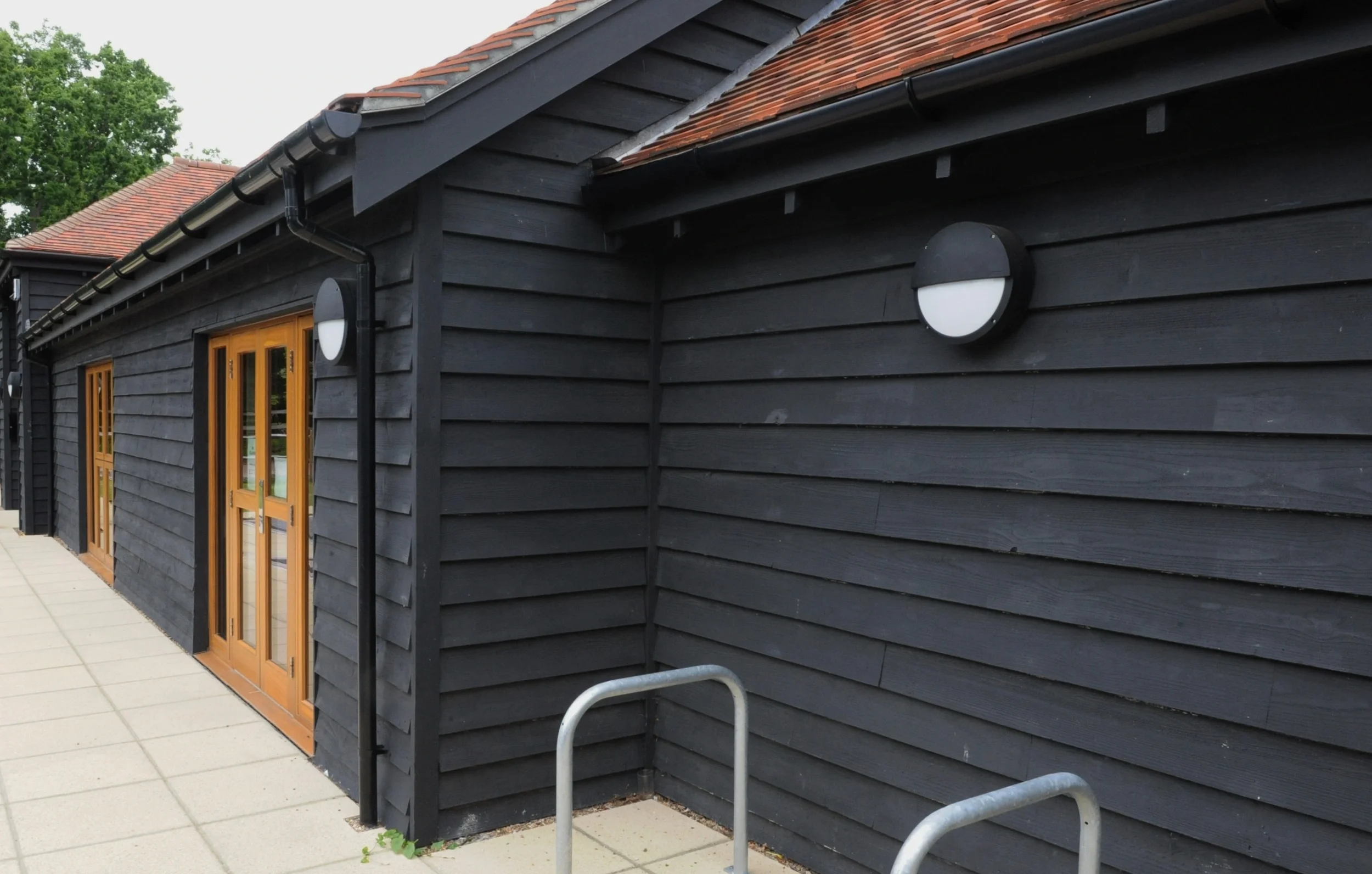
Village Hall in blacked feather edge larch cladding.
Larch for cladding
Our homegrown British Larch is a sustainable timber that offers excellent value for money. It’s tough, naturally durable, and contains a high resin content that helps protect it from decay. A true all-rounder, British Larch is suitable for both modern and older properties and performs well in exposed locations.
The timber ranges in colour from warm yellow to reddish-brown and weathers slowly to a silvery-grey if left untreated. It features interesting grain patterns and small, scattered knots that add character. Larch also offers excellent thermal and acoustic properties, making it as practical as it is attractive. We offer British Larch in sawn profiles — feather-edge, square-edge, and waney-edge — for a more rustic appearance ideal for barn conversions, rural properties, and timber-framed buildings.
We can also supply Canadian Larch TGV cladding, which has an interlocking edge for a smooth, refined finish and a waterproof façade. This profile is ideal for homes, garden structures, and commercial buildings.
Summarising the key features of larch cladding:
Durable — no need to treat, will last decades
Hard and tough, ideal for exposed areas
More affordable than Cedar
Unstable timber — may shrink/expand and distort if not installed correctly
Western Red Cedar for cladding
Western Red Cedar is one of the most popular cladding timbers in the UK, valued for its natural durability, lightweight structure, and stability. It has an attractive reddish-brown colour and a distinctive aromatic scent. Cedar is exceptionally stable — it stays straight and true for decades, even without treatment. And, because it contains no resin, it accepts paints and stains exceptionally well if a surface finish is desired.
Our homegrown British Western Red Cedar is sourced from responsibly managed local woodlands. While it is more knotty and less dense than Canadian Cedar, it is significantly less expensive and has a much lower carbon footprint due to reduced transport miles. We offer this in sawn cladding profiles only.
Our Canadian Western Red Cedar is considered the No. 1 choice in the UK for premium cladding. It’s available in a wide range of machined profiles — halflap, shiplap, TGV, and rainscreen — making it adaptable for everything from high-end residential façades to contemporary garden rooms.
Summarising the key benefits of Western Red Cedar:
Naturally durable and stable
Lightweight and easy to work with
Exceptional lifespan with minimal maintenance
Resin-free — excellent for painting and staining
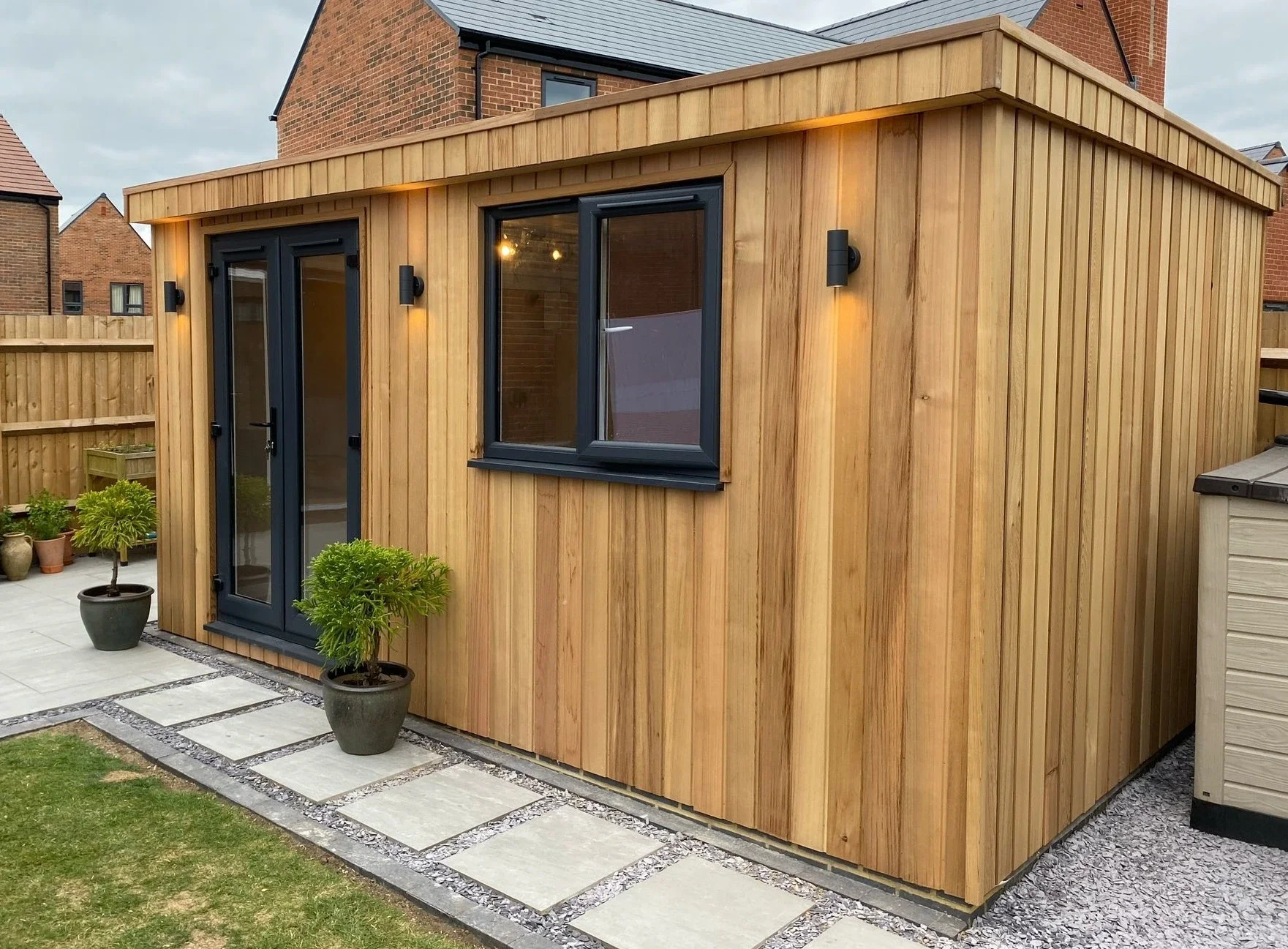
Garden Room with machined Western Red Cedar cladding.
Larch vs Western Red Cedar Cladding
When deciding between Larch vs Western Red Cedar cladding, it’s worth looking closely at how the two species compare across the main factors that affect performance, appearance, and cost.
Durability and weather resistance
Both Larch and Western Red Cedar are naturally durable and well-suited to the varied conditions of the UK climate. Larch is a dense, tough softwood with a high resin content that helps protect it from decay, making it particularly well-suited for exposed areas such as coastal properties or rural buildings subject to driving rain and wind. It is also more resistant to impact damage, which can be useful for areas prone to knocks and wear.
Western Red Cedar is lighter in weight but exceptionally stable, meaning it is far less likely to cup, twist, or split over time - even without any surface treatment. This stability makes it a strong choice for precise architectural designs where clean lines and minimal movement are a priority.
Appearance and colour change
British Larch has a warm, rustic charm with colours ranging from golden yellow to reddish-brown, often featuring small, characterful knots and distinctive grain patterns. Canadian Larch offers a more refined, even-grained appearance, suiting projects that require a cleaner finish.
Western Red Cedar is renowned for its richer, more uniform colour palette, which can range from pinkish-brown through to deep red tones. Its grain is generally smoother than Larch, and it has a distinctive aromatic scent. Over time, both timbers will weather to a silver-grey when left untreated, but Cedar tends to fade more evenly, while Larch may develop a more varied patina depending on sun exposure and weather patterns.
Maintenance
Neither Larch nor Cedar requires chemical treatment to achieve a long lifespan — both can last decades with minimal intervention. If the goal is to preserve the original colour, regular application of a UV-protective oil or stain is essential.
Due to its natural stability, Cedar often requires less frequent attention to maintain an even appearance, while Larch may need closer monitoring to manage any minor movement or surface checking in exposed areas. Regardless of species, a basic cleaning routine to remove dirt and debris will help maintain the timber’s appearance and performance.
Sustainability
From an environmental perspective, both timbers can be excellent choices when sourced responsibly. Our British-grown Larch and Cedar have the added advantage of lower transportation miles, reducing their carbon footprint and supporting local forestry.
Canadian Larch and Canadian Western Red Cedar are imported, but all of our supply is sourced from well-managed, certified forests that adhere to strict sustainability and biodiversity standards. This ensures the timber is harvested with long-term forest health in mind.
Cost and availability
In terms of price, British Larch is the most cost-effective option, offering durability and attractive character at a competitive rate. British Western Red Cedar is the next step up in cost, providing the benefits of Cedar at a more accessible price point than imported grades.
Canadian Larch and Canadian Western Red Cedar sit in the premium category, with Cedar typically commanding the highest price due to its reputation, stability, and limited growing regions. Availability can also differ — British-grown Larch and Cedar are often more readily available, while imported Canadian timbers may have longer lead times depending on demand and profile choice.
| Feature | Larch | Western Red Cedar |
|---|---|---|
| Durability | British Larch: Class 3 – good resistance to decay | Class 2 – excellent resistance to decay and insects |
| Appearance | Pale yellow to golden brown with visible grain patterns | Reddish-pink to rich brown, smooth grain, colour variation |
| Maintenance | Low if left to weather; regular oiling needed to retain colour | Low; retains a more even tone when weathering naturally |
| Sustainability | Available FSC-certified; British option reduces transport footprint | Available FSC-certified; imported from Canada |
| Cost | More affordable – cost-effective for large projects | Premium price – suited to high-end designs |
Choosing the right timber for your cladding project
If you’re looking for an affordable, tough, and characterful timber that performs well in exposed locations, British Larch is a great choice. For a more refined appearance, Canadian Larch offers a smoother profile with the same durability. If stability, premium appearance, and low movement are your priorities, Western Red Cedar - particularly Canadian - is hard to beat. British Cedar provides a more economical alternative while still offering the same natural durability.
Not sure whether Larch or Western Red Cedar is the best choice for your cladding project? Our expert team at WL West Timber can guide you through the decision, taking into account your design preferences, budget, and performance requirements. We’ll help you compare the options, choose the right profile, and ensure your timber is perfectly suited to your location and intended use.
At WL West Timber, we supply premium British and Canadian Larch and Western Red Cedar in a wide range of profiles, all sourced sustainably and prepared to the highest standards. Whether you’re working on a contemporary home, a traditional barn conversion, or a commercial build, our team can help you select the perfect timber, calculate the quantities you need, and arrange delivery direct to site. Contact us today for expert advice, a tailored quotation, or to request samples.